How to create SEO-friendly Vietnamese slugs
Turn Vietnamese titles into short, readable, stable URLs.
Quick answer: Use lowercase words separated by hyphens, remove Vietnamese diacritics and unnecessary punctuation, and keep the phrase that best describes the page. A slug should be understandable, not a copy of every word in the title.
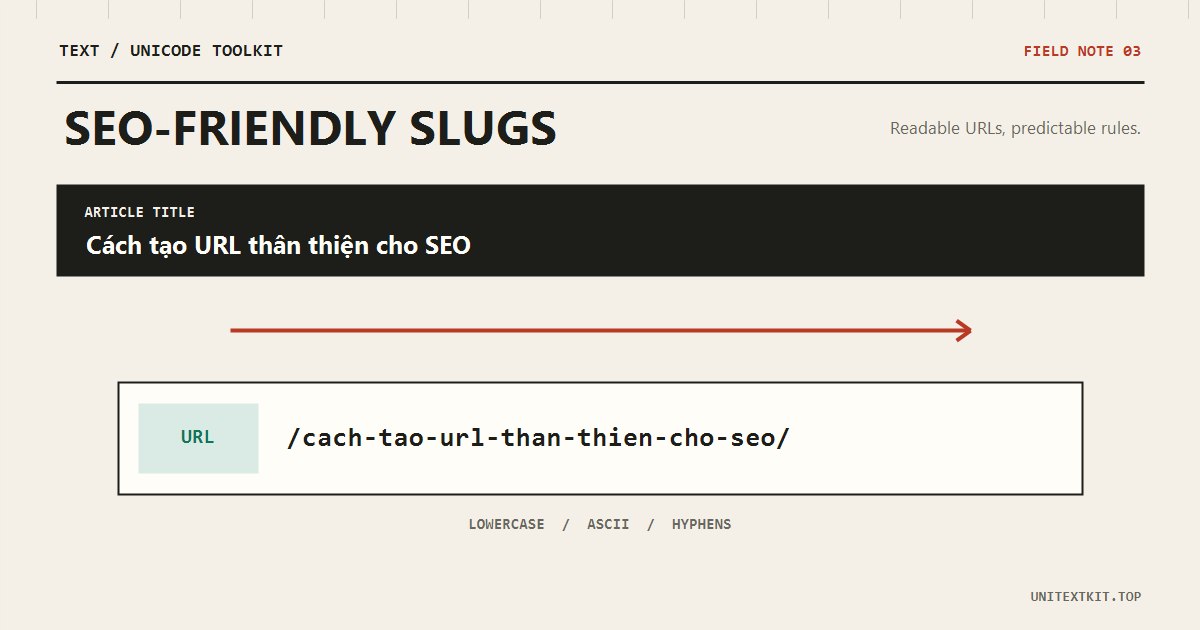
A maintainable slug pattern
Start with the title, remove diacritics, map đ to d, lowercase the text, and join words with hyphens. Keep enough words to identify the subject. Avoid dates if the page is intended to stay evergreen.
Before
Cách tạo Slug tiếng Việt chuẩn SEO năm 2026
After
cach-tao-slug-tieng-viet-chuan-seo
Common mistakes
Avoid random identifiers, tracking parameters, repeated keywords, and words that add no meaning. If two pages produce the same slug, add a descriptive qualifier rather than an arbitrary number.
The slug is only one search signal. Useful content, a clear title, internal links, and intent match matter more than polishing a URL indefinitely.
Changing an existing slug
Changing a published URL can break links. Add a permanent redirect, update internal links, canonical tags, and the sitemap. If the current slug is clear and already receives traffic, leaving it in place is often safer.
Frequently asked questions
Must the primary keyword appear in the slug?
Use a natural phrase that describes the subject. Repeating keyword variants does not help readers.
Can URLs keep Vietnamese accents?
Browsers support Unicode URLs, but unaccented slugs are usually easier to type, copy, and exchange between systems.